import torch
import numpy as np
import matplotlib.pyplot as plt 02wk-2: (회귀) – 파라메터의 학습과정 음미, MSE, 파이토치식 코딩패턴 (1)

1. 강의영상
2. Imports
plt.rcParams['figure.figsize'] = (4.5, 3.0)3. 선택학습: 데이터시각화
- 데이터시각화2023: https://guebin.github.io/DV2023/
4. 파라메터의 학습과정 음미
torch.manual_seed(43052)
x,_ = torch.randn(100).sort()
eps = torch.randn(100)*0.5
X = torch.stack([torch.ones(100),x],axis=1)
W = torch.tensor([[2.5],[4.0]])
y = X@W + eps.reshape(100,1)
x = X[:,[1]]# 지난시간복습
# 지도학습문제: (x,y) 관찰하고 x -> y 인 패턴을 찾는 문제 (지도학습문제, supervised learning)
# 모델링: (x,y) 관찰을 해보니까 scatter plot이 직선의 모양을 하고 있음.. --> 패턴이 직선이겠네? --> y=X@W+ϵ
## - 모델: y=X@W+ϵ // y 물결 X@W
# 학습: 결국 회귀분석문제는 What을 찾는 문제 // 파라메터 What의 값을 update하는 과정을 학습
# 학습의방법?
# 1. yhat을 구한다. <-- 모델링 (도메인지식이 정통한 어떤 사람)
# 2. loss를 계산한다. <-- 손실함수를 설계 (통계)
# 3. loss미분한다. <-- 미분을 계산하는 torch와 같은 프로그램이 있어야함 (컴퓨터공학과)
# 4. update한다. <-- 업데이트공식이 있었음. 이걸 알아야함. (산공)A. print
What = torch.tensor([[-5.0],[10.0]],requires_grad=True)
alpha = 0.001
print(f"시작값 = {What.data.reshape(-1)}")
for epoc in range(30):
yhat = X @ What
loss = torch.sum((y-yhat)**2)
loss.backward()
What.data = What.data - alpha * What.grad
print(f'loss = {loss:.2f} \t 업데이트폭 = {-alpha * What.grad.reshape(-1)} \t 업데이트결과: {What.data.reshape(-1)}')
What.grad = None시작값 = tensor([-5., 10.])
loss = 8587.69 업데이트폭 = tensor([ 1.3423, -1.1889]) 업데이트결과: tensor([-3.6577, 8.8111])
loss = 5675.21 업데이트폭 = tensor([ 1.1029, -0.9499]) 업데이트결과: tensor([-2.5548, 7.8612])
loss = 3755.64 업데이트폭 = tensor([ 0.9056, -0.7596]) 업데이트결과: tensor([-1.6492, 7.1016])
loss = 2489.58 업데이트폭 = tensor([ 0.7431, -0.6081]) 업데이트결과: tensor([-0.9061, 6.4935])
loss = 1654.04 업데이트폭 = tensor([ 0.6094, -0.4872]) 업데이트결과: tensor([-0.2967, 6.0063])
loss = 1102.32 업데이트폭 = tensor([ 0.4995, -0.3907]) 업데이트결과: tensor([0.2028, 5.6156])
loss = 737.84 업데이트폭 = tensor([ 0.4091, -0.3136]) 업데이트결과: tensor([0.6119, 5.3020])
loss = 496.97 업데이트폭 = tensor([ 0.3350, -0.2519]) 업데이트결과: tensor([0.9469, 5.0501])
loss = 337.71 업데이트폭 = tensor([ 0.2742, -0.2025]) 업데이트결과: tensor([1.2211, 4.8477])
loss = 232.40 업데이트폭 = tensor([ 0.2243, -0.1629]) 업데이트결과: tensor([1.4454, 4.6848])
loss = 162.73 업데이트폭 = tensor([ 0.1834, -0.1311]) 업데이트결과: tensor([1.6288, 4.5537])
loss = 116.63 업데이트폭 = tensor([ 0.1500, -0.1056]) 업데이트결과: tensor([1.7787, 4.4480])
loss = 86.13 업데이트폭 = tensor([ 0.1226, -0.0851]) 업데이트결과: tensor([1.9013, 4.3629])
loss = 65.93 업데이트폭 = tensor([ 0.1001, -0.0687]) 업데이트결과: tensor([2.0014, 4.2942])
loss = 52.57 업데이트폭 = tensor([ 0.0818, -0.0554]) 업데이트결과: tensor([2.0832, 4.2388])
loss = 43.72 업데이트폭 = tensor([ 0.0668, -0.0447]) 업데이트결과: tensor([2.1500, 4.1941])
loss = 37.86 업데이트폭 = tensor([ 0.0545, -0.0361]) 업데이트결과: tensor([2.2045, 4.1579])
loss = 33.97 업데이트폭 = tensor([ 0.0445, -0.0292]) 업데이트결과: tensor([2.2490, 4.1287])
loss = 31.40 업데이트폭 = tensor([ 0.0363, -0.0236]) 업데이트결과: tensor([2.2853, 4.1051])
loss = 29.70 업데이트폭 = tensor([ 0.0296, -0.0191]) 업데이트결과: tensor([2.3150, 4.0860])
loss = 28.57 업데이트폭 = tensor([ 0.0242, -0.0155]) 업데이트결과: tensor([2.3392, 4.0705])
loss = 27.83 업데이트폭 = tensor([ 0.0197, -0.0125]) 업데이트결과: tensor([2.3589, 4.0580])
loss = 27.33 업데이트폭 = tensor([ 0.0161, -0.0101]) 업데이트결과: tensor([2.3750, 4.0479])
loss = 27.00 업데이트폭 = tensor([ 0.0131, -0.0082]) 업데이트결과: tensor([2.3881, 4.0396])
loss = 26.79 업데이트폭 = tensor([ 0.0107, -0.0067]) 업데이트결과: tensor([2.3988, 4.0330])
loss = 26.64 업데이트폭 = tensor([ 0.0087, -0.0054]) 업데이트결과: tensor([2.4075, 4.0276])
loss = 26.55 업데이트폭 = tensor([ 0.0071, -0.0044]) 업데이트결과: tensor([2.4146, 4.0232])
loss = 26.48 업데이트폭 = tensor([ 0.0058, -0.0035]) 업데이트결과: tensor([2.4204, 4.0197])
loss = 26.44 업데이트폭 = tensor([ 0.0047, -0.0029]) 업데이트결과: tensor([2.4251, 4.0168])
loss = 26.41 업데이트폭 = tensor([ 0.0038, -0.0023]) 업데이트결과: tensor([2.4290, 4.0144])B. 시각화 – yhat의 관점에서!
What = torch.tensor([[-5.0],[10.0]],requires_grad=True)
alpha = 0.001
plt.plot(x,y,'o',label = "observed")
fig = plt.gcf()
ax = fig.gca()
ax.plot(x,X@What.data,'--',color="C1")
for epoc in range(30):
yhat = X @ What
loss = torch.sum((y-yhat)**2)
loss.backward()
What.data = What.data - alpha * What.grad
ax.plot(x,X@What.data,'--',color="C1",alpha=0.1)
What.grad = None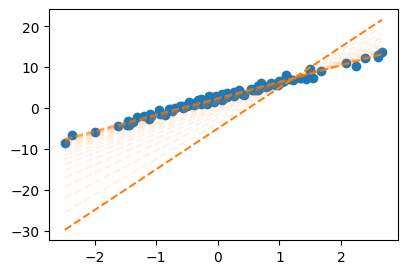
C. 시각화 – loss의 관점에서!!
def plot_loss():
fig = plt.figure()
ax = fig.add_subplot(projection='3d')
w0 = np.arange(-6, 11, 0.5)
w1 = np.arange(-6, 11, 0.5)
W1,W0 = np.meshgrid(w1,w0)
LOSS=W0*0
for i in range(len(w0)):
for j in range(len(w1)):
LOSS[i,j]=torch.sum((y-w0[i]-w1[j]*x)**2)
ax.plot_surface(W0, W1, LOSS, rstride=1, cstride=1, color='b',alpha=0.1)
ax.azim = 30 ## 3d plot의 view 조절
ax.dist = 8 ## 3d plot의 view 조절
ax.elev = 5 ## 3d plot의 view 조절
ax.set_xlabel(r'$w_0$') # x축 레이블 설정
ax.set_ylabel(r'$w_1$') # y축 레이블 설정
ax.set_xticks([-5,0,5,10]) # x축 틱 간격 설정
ax.set_yticks([-5,0,5,10]) # y축 틱 간격 설정
plt.close(fig) # 자동 출력 방지
return fig# 손실 8587.6875 를 계산하는 또 다른 방식
def l(w0hat,w1hat):
yhat = w0hat + w1hat*x
return torch.sum((y-yhat)**2)fig = plot_loss()
ax = fig.gca()
ax.scatter(2.5, 4, l(2.5,4), s=200, marker='*', color='red', label=r"${\bf W}=[2.5, 4]'$")
ax.scatter(-5, 10, l(-5,10), s=200, marker='*', color='blue', label=r"initial $\hat{\bf W}=[-5, 10]'$")
ax.legend()
fig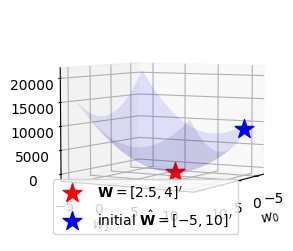
What = torch.tensor([[-5.0],[10.0]],requires_grad=True)
alpha = 0.001
for epoc in range(30):
yhat = X @ What
loss = torch.sum((y-yhat)**2)
loss.backward()
What.data = What.data - 0.001 * What.grad
w0,w1 = What.data.reshape(-1)
ax.scatter(w0,w1,l(w0,w1),s=5,marker='o',color='blue')
What.grad = Nonefig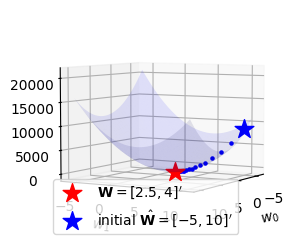
D. 애니메이션
from matplotlib import animationplt.rcParams['figure.figsize'] = (7.5,2.5)
plt.rcParams["animation.html"] = "jshtml" def show_animation(alpha=0.001):
## 1. 히스토리 기록을 위한 list 초기화
loss_history = []
yhat_history = []
What_history = []
## 2. 학습 + 학습과정기록
What= torch.tensor([[-5.0],[10.0]],requires_grad=True)
What_history.append(What.data.tolist())
for epoc in range(30):
yhat=X@What ; yhat_history.append(yhat.data.tolist())
loss=torch.sum((y-yhat)**2); loss_history.append(loss.item())
loss.backward()
What.data = What.data - alpha * What.grad; What_history.append(What.data.tolist())
What.grad = None
## 3. 시각화
fig = plt.figure()
ax1 = fig.add_subplot(1, 2, 1)
ax2 = fig.add_subplot(1, 2, 2, projection='3d')
#### ax1: yhat의 관점에서..
ax1.plot(x,y,'o',label=r"$(x_i,y_i)$")
line, = ax1.plot(x,yhat_history[0],label=r"$(x_i,\hat{y}_i)$")
ax1.legend()
#### ax2: loss의 관점에서..
w0 = np.arange(-6, 11, 0.5)
w1 = np.arange(-6, 11, 0.5)
W1,W0 = np.meshgrid(w1,w0)
LOSS=W0*0
for i in range(len(w0)):
for j in range(len(w1)):
LOSS[i,j]=torch.sum((y-w0[i]-w1[j]*x)**2)
ax2.plot_surface(W0, W1, LOSS, rstride=1, cstride=1, color='b',alpha=0.1)
ax2.azim = 30 ## 3d plot의 view 조절
ax2.dist = 8 ## 3d plot의 view 조절
ax2.elev = 5 ## 3d plot의 view 조절
ax2.set_xlabel(r'$w_0$') # x축 레이블 설정
ax2.set_ylabel(r'$w_1$') # y축 레이블 설정
ax2.set_xticks([-5,0,5,10]) # x축 틱 간격 설정
ax2.set_yticks([-5,0,5,10]) # y축 틱 간격 설정
ax2.scatter(2.5, 4, l(2.5,4), s=200, marker='*', color='red', label=r"${\bf W}=[2.5, 4]'$")
ax2.scatter(-5, 10, l(-5,10), s=200, marker='*', color='blue')
ax2.legend()
def animate(epoc):
line.set_ydata(yhat_history[epoc])
ax2.scatter(np.array(What_history)[epoc,0],np.array(What_history)[epoc,1],loss_history[epoc],color='grey')
fig.suptitle(f"alpha = {alpha} / epoch = {epoc}")
return line
ani = animation.FuncAnimation(fig, animate, frames=30)
plt.close()
return aniani = show_animation(alpha=0.001)
aniE. 학습률에 따른 시각화
- \(\alpha\)가 너무 작다면 비효율적임
show_animation(alpha=0.0001)- \(\alpha\)가 크다고 무조건 좋은건 또 아님
show_animation(alpha=0.0083)- 수틀리면 수렴안할수도??
show_animation(alpha=0.0085)- 그냥 망할수도??
show_animation(alpha=0.01)plt.rcdefaults()
plt.rcParams['figure.figsize'] = 4.5,3.0 5. SSE \(\to\) MSE
- 학습률을 잘 선택하는 것이 중요함
- 손실함수를 SSE로 설정하면 학습률 선택이 비효율적 \(\to\) SSE말고 MSE를 써야함
손실함수가 SSE일때코드
What = torch.tensor([[-5.0],[10.0]],requires_grad = True)
for epoc in range(30):
# step1: yhat
yhat = X@What
# step2: loss
loss = torch.sum((y-yhat)**2)
# step3: 미분
loss.backward()
# step4: update
What.data = What.data - 0.001 * What.grad
What.grad = NoneWhat.datatensor([[2.4290],
[4.0144]])손실함수가 MSE일때코드
What = torch.tensor([[-5.0],[10.0]],requires_grad = True)
for epoc in range(30):
# step1: yhat
yhat = X@What
# step2: loss
loss = torch.sum((y-yhat)**2)/100 # torch.mean((y-yhat)**2)
# step3: 미분
loss.backward()
# step4: update
What.data = What.data - 0.1 * What.grad
What.grad = NoneWhat.datatensor([[2.4290],
[4.0144]])6. 파이토치식 코딩패턴 (1)
torch.manual_seed(43052)
x,_ = torch.randn(100).sort()
eps = torch.randn(100)*0.5
X = torch.stack([torch.ones(100),x],axis=1)
W = torch.tensor([[2.5],[4.0]])
y = X@W + eps.reshape(100,1)
x = X[:,[1]]A. 기본패턴
## -- 외우세요!!! -- ##
What = torch.tensor([[-5.0],[10.0]],requires_grad = True)
for epoc in range(30):
# step1: yhat
yhat = X@What
# step2: loss
loss = torch.sum((y-yhat)**2)/100
# step3: 미분
loss.backward()
# step4: update
What.data = What.data - 0.1 * What.grad
What.grad = Noneplt.plot(x,y,'o')
plt.plot(x,X@What.data,'--')
plt.title(f'What={What.data.reshape(-1)}');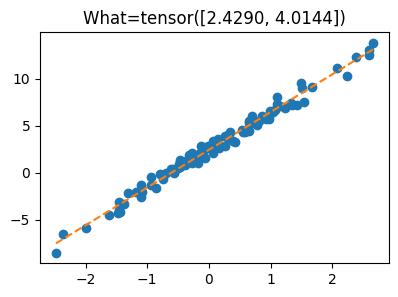
B. Step2의 수정 – loss_fn 이용
What = torch.tensor([[-5.0],[10.0]],requires_grad = True)
loss_fn = torch.nn.MSELoss()
for epoc in range(30):
# step1: yhat
yhat = X@What
# step2: loss
#loss = torch.sum((y-yhat)**2)/100
loss = loss_fn(yhat,y) # 여기서는 큰 상관없지만 습관적으로 yhat을 먼저넣는 연습을 하자!!
# step3: 미분
loss.backward()
# step4: update
What.data = What.data - 0.1 * What.grad
What.grad = Noneplt.plot(x,y,'o')
plt.plot(x,X@What.data,'--')
plt.title(f'What={What.data.reshape(-1)}');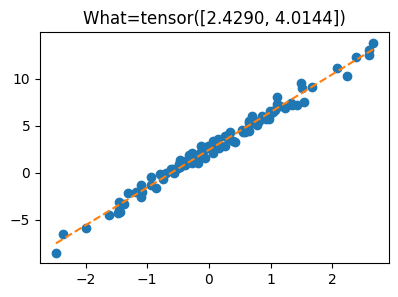
C. Step1의 수정 – net 이용
# net – net 오브젝트란?
원래 yhat을 이런식으로 구했는데 ~
What = torch.tensor([[-5.0],[10.0]],requires_grad = True)
yhat= X@What
yhat[:5]tensor([[-29.8211],
[-28.6215],
[-24.9730],
[-21.2394],
[-19.7919]], grad_fn=<SliceBackward0>)아래와 같은 방식으로 코드를 짜고 싶음..
yhat = net(X) # 위와 같은 코드를 가능하게 하는 net은 torch에서 지원하고 아래와 같이 사용할 수 있음.
# yhat = net(X)
net = torch.nn.Linear(
in_features=2, # X:(n,2) --> 2
out_features=1, # yhat:(n,1) --> 1
bias=False
)net.weight.data = torch.tensor([[-5.0], [10.0]]).T # .T 를 해야함. 외우세요
net.weightParameter containing:
tensor([[-5., 10.]], requires_grad=True)net(X)[:5]tensor([[-29.8211],
[-28.6215],
[-24.9730],
[-21.2394],
[-19.7919]], grad_fn=<SliceBackward0>)(X@What)[:5]tensor([[-29.8211],
[-28.6215],
[-24.9730],
[-21.2394],
[-19.7919]], grad_fn=<SliceBackward0>)(X@net.weight.T)[:5]tensor([[-29.8211],
[-28.6215],
[-24.9730],
[-21.2394],
[-19.7919]], grad_fn=<SliceBackward0>)#
- 수정된코드
# step1을 위한 사전준비
net = torch.nn.Linear(
in_features=2,
out_features=1,
bias=False
)
net.weight.data = torch.tensor([[-5.0, 10.0]])
# step2를 위한 사전준비
loss_fn = torch.nn.MSELoss()
for epoc in range(30):
# step1: yhat
# yhat = X@What
yhat = net(X)
# step2: loss
loss = loss_fn(yhat,y)
# step3: 미분
loss.backward()
# step4: update
net.weight.data = net.weight.data - 0.1 * net.weight.grad
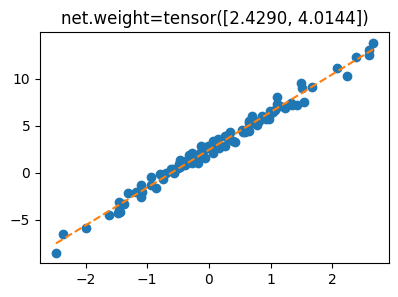
net.weight.grad = Noneplt.plot(x,y,'o')
plt.plot(x,net(X).data,'--')
plt.title(f'net.weight={net.weight.data.reshape(-1)}');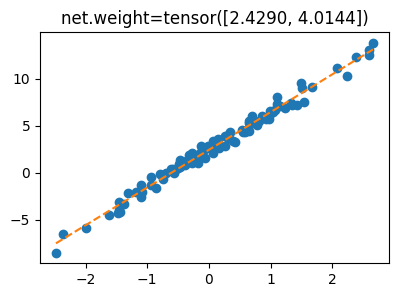
D. Step4의 수정 – optimizer의 이용
- 소망: 아래의 과정을 좀 더 편하게 했으면..
net.weight.data = net.weight.data - 0.1 * net.weight.grad
net.weight.data = None # optimizer – 이걸 이용하면 update 과정을 손쉽게 할 수 있음
기존코드
## -- 준비과정 -- ##
# step1을 위한 사전준비
net = torch.nn.Linear(
in_features=2,
out_features=1,
bias=False
)
net.weight.data = torch.tensor([[-5.0, 10.0]])
# step2를 위한 사전준비
loss_fn = torch.nn.MSELoss()## -- 1에폭진행 -- ##
# step1:
yhat = net(X)
# step2: loss
loss = loss_fn(yhat,y)
# step3: 미분
loss.backward()
# step4: update
print(net.weight.data)
net.weight.data = net.weight.data - 0.1 * net.weight.grad
print(net.weight.data)
net.weight.grad = Nonetensor([[-5., 10.]])
tensor([[-3.6577, 8.8111]])## -- 2에폭진행 -- ##
# step1: 2에폭진행
yhat = net(X)
# step2: loss
loss = loss_fn(yhat,y)
# step3: 미분
loss.backward()
# step4: update
print(net.weight.data)
net.weight.data = net.weight.data - 0.1 * net.weight.grad
print(net.weight.data)
net.weight.grad = Nonetensor([[-3.6577, 8.8111]])
tensor([[-2.5548, 7.8612]])새로운코드 – optimizer 이용
## -- 준비과정 -- ##
# step1을 위한 사전준비
net = torch.nn.Linear(
in_features=2,
out_features=1,
bias=False
)
net.weight.data = torch.tensor([[-5.0, 10.0]])
# step2를 위한 사전준비
loss_fn = torch.nn.MSELoss()
# step4를 위한 사전준비
optimizr = torch.optim.SGD(net.parameters(),lr=0.1)## -- 1에폭진행 -- ##
yhat = net(X)
# step2: loss
loss = loss_fn(yhat,y)
# step3: 미분
loss.backward()
# step4: update
print(net.weight.data)
#net.weight.data = net.weight.data - 0.1 * net.weight.grad
optimizr.step()
print(net.weight.data)
#net.weight.grad = None
optimizr.zero_grad()tensor([[-5., 10.]])
tensor([[-3.6577, 8.8111]])## -- 2에폭진행 -- ##
yhat = net(X)
# step2: loss
loss = loss_fn(yhat,y)
# step3: 미분
loss.backward()
# step4: update
print(net.weight.data)
#net.weight.data = net.weight.data - 0.1 * net.weight.grad
optimizr.step()
print(net.weight.data)
#net.weight.grad = None
optimizr.zero_grad()tensor([[-3.6577, 8.8111]])
tensor([[-2.5548, 7.8612]])#
- 수정된코드
# step1을 위한 사전준비
net = torch.nn.Linear(
in_features=2,
out_features=1,
bias=False
)
net.weight.data = torch.tensor([[-5.0, 10.0]])
# step2를 위한 사전준비
loss_fn = torch.nn.MSELoss()
# step4를 위한 사전준비
optimizr = torch.optim.SGD(net.parameters(),lr=0.1)
for epoc in range(30):
# step1: yhat
yhat = net(X)
# step2: loss
loss = loss_fn(yhat,y)
# step3: 미분
loss.backward()
# step4: update
optimizr.step()
optimizr.zero_grad()plt.plot(x,y,'o')
plt.plot(x,yhat.data,'--')
plt.title(f'net.weight={net.weight.data.reshape(-1)}');