import torch
import numpy as np
import matplotlib.pyplot as plt
#--# 문제1
import pandas as pd
import sklearn.model_selection
#--# 문제3
import gymnasium as gym
import IPython
from matplotlib.animation import FuncAnimation
import collections
import random15wk-2: 기말고사

1. 추천시스템 – 30점
!wget http://files.grouplens.org/datasets/movielens/ml-20m.zip
!unzip ml-20m.zip
--2024-06-16 15:03:12-- http://files.grouplens.org/datasets/movielens/ml-20m.zip
Resolving files.grouplens.org (files.grouplens.org)... 128.101.65.152
Connecting to files.grouplens.org (files.grouplens.org)|128.101.65.152|:80... connected.
HTTP request sent, awaiting response... 200 OK
Length: 198702078 (189M) [application/zip]
Saving to: ‘ml-20m.zip’
ml-20m.zip 100%[===================>] 189.50M 2.83MB/s in 65s
2024-06-16 15:04:17 (2.94 MB/s) - ‘ml-20m.zip’ saved [198702078/198702078]
Archive: ml-20m.zip
creating: ml-20m/
inflating: ml-20m/genome-scores.csv
inflating: ml-20m/genome-tags.csv
inflating: ml-20m/links.csv
inflating: ml-20m/movies.csv
inflating: ml-20m/ratings.csv
inflating: ml-20m/README.txt
inflating: ml-20m/tags.csv MovieLens 20M 데이터셋은 GroupLens Research에서 제공하는 영화 평점 데이터셋으로, 영화 추천 시스템 연구에 널리 사용된다. 이 데이터셋은 약 2천만 개의 영화 평점과 메타데이터를 포함하고 있다. 주요 파일과 그 내용은 다음과 같다:
1. ratings.csv:
- userId: 사용자의 고유 ID
- movieId: 영화의 고유 ID
- rating: 사용자가 부여한 평점 (1.0에서 5.0 사이의 값)
- timestamp: 평점이 부여된 시간 (유닉스 타임스탬프 형식)
2. movies.csv:
- movieId: 영화의 고유 ID
- title: 영화 제목
- genres: 영화 장르 (여러 개의 장르가 ’|’로 구분됨)
3. tags.csv:
- userId: 사용자의 고유 ID
- movieId: 영화의 고유 ID
- tag: 사용자가 부여한 태그
- timestamp: 태그가 부여된 시간 (유닉스 타임스탬프 형식)
4. genome-scores.csv:
- movieId: 영화의 고유 ID
- tagId: 태그의 고유 ID
- relevance: 해당 태그가 영화에 얼마나 관련 있는지 나타내는 점수 (0.0에서 1.0 사이의 값)
5. genome-tags.csv:
- tagId: 태그의 고유 ID
- tag: 태그의 이름
6. links.csv:
- movieId: 영화의 고유 ID
- imdbId: IMDB에서의 영화 ID
- tmdbId: TMDB에서의 영화 ID
이중에서 1,2의 데이터만 사용하여 추천시스템을 설계하기로 하자.
np.random.seed(43052)
df_ratings = pd.read_csv("ml-20m/ratings.csv")
df_movies = pd.read_csv("ml-20m/movies.csv")
df_train_all = pd.merge(df_ratings,df_movies)
userId_sampled = np.random.choice(df_train_all.userId.unique(),5000,replace=False); userId_sampled[0] = 46889
df_train = df_train_all.query("userId in @userId_sampled").reset_index(drop=True)
df_train["userId"] = df_train.userId.map({user:i for i,user in enumerate(set(df_train.userId))})
df_train["movieId"] = df_train.movieId.map({movie:i for i,movie in enumerate(set(df_train.movieId))})
평점정보와 영화정보를 결합하여 df_train을 만들었으며, 위의 코드를 간단히 설명하면 아래와 같다.
1. df_ratings와 df_movies CSV 파일을 읽어 데이터프레임으로 만든다.
df_ratings = pd.read_csv("ml-20m/ratings.csv")
df_movies = pd.read_csv("ml-20m/movies.csv")2. 평점 데이터와 영화 데이터를 합쳐 하나의 데이터프레임 df_train_all을 만든다.
df_train_all = pd.merge(df_ratings, df_movies)3. 데이터가 너무 많아 5000명의 유저만 랜덤으로 샘플링한다. (이때 유저 46889는 반드시 포함)
userId_sampled = np.random.choice(df_train_all.userId.unique(), 5000, replace=False); userId_sampled[0] = 468894. 샘플링된 5000명의 유저 데이터만 포함하는 새로운 데이터프레임 df_train을 만든다.
df_train = df_train_all.query("userId in @userId_sampled").reset_index(drop=True)5. 유저 ID를 0부터 시작하는 인덱스로 재조정한다.
df_train["userId"] = df_train.userId.map({user: i for i, user in enumerate(set(df_train.userId))})6. 영화 ID도 0부터 시작하는 인덱스로 재조정한다.
df_train["movieId"] = df_train.movieId.map({movie: i for i, movie in enumerate(set(df_train.movieId))})df_train| userId | movieId | rating | timestamp | title | genres | |
|---|---|---|---|---|---|---|
| 0 | 32 | 1 | 3.5 | 1162148886 | Jumanji (1995) | Adventure|Children|Fantasy |
| 1 | 97 | 1 | 1.5 | 1270074943 | Jumanji (1995) | Adventure|Children|Fantasy |
| 2 | 104 | 1 | 4.0 | 832087680 | Jumanji (1995) | Adventure|Children|Fantasy |
| 3 | 143 | 1 | 5.0 | 1169362252 | Jumanji (1995) | Adventure|Children|Fantasy |
| 4 | 154 | 1 | 3.0 | 837155475 | Jumanji (1995) | Adventure|Children|Fantasy |
| ... | ... | ... | ... | ... | ... | ... |
| 721479 | 160 | 10694 | 3.0 | 1301694248 | Sube y Baja (1959) | Comedy |
| 721480 | 160 | 10945 | 2.0 | 1306489841 | Mosquito Net, The (La mosquitera) (2010) | Drama |
| 721481 | 160 | 10999 | 3.0 | 1307711243 | Bicycle, Spoon, Apple (Bicicleta, cullera, poma) | Documentary |
| 721482 | 160 | 11139 | 3.0 | 1310106628 | Welcome Farewell-Gutmann (Bienvenido a Farewel... | Comedy|Drama |
| 721483 | 160 | 11188 | 3.5 | 1311319470 | Concursante (2007) | Comedy|Drama |
721484 rows × 6 columns
(1) df_train을 아래와 같이 X_train, X_val, y_train, y_val로 나누고 적절한 추천시스템을 설계하고 학습하라. 학습결과를 validation loss로 검증하라.
X1 = torch.tensor(df_train.userId)
X2 = torch.tensor(df_train.movieId)
X = torch.stack([X1,X2],axis=1)
y = torch.tensor(df_train.rating).float().reshape(-1,1)
X_train,X_val,y_train,y_val = sklearn.model_selection.train_test_split(X,y,test_size=0.1,random_state=42)힌트1: 11wk-1, 5-A (풀이2)를 참고하세요
힌트2: 아래의 코드를 이용하세요..
class Net(torch.nn.Module):
    def __init__(self):
        super().__init__()
        #--#
        ????
    def forward(self,X):
        ???
        return yhat
#---#
net = Net()
loss_fn = torch.nn.MSELoss()
optimizr = torch.optim.Adam(net.parameters())
ds = torch.utils.data.TensorDataset(X_train,y_train)
dl = torch.utils.data.DataLoader(ds,batch_size=64,shuffle=True)
#--#
for epoc in range(5):
    net.to("cuda:0")
    for xi,yi in dl:
        xi = xi.to("cuda:0")
        yi = yi.to("cuda:0")
        # 1
        yi_hat = net(xi)
        # 2
        loss = loss_fn(yi_hat,yi)
        # 3
        loss.backward()
        # 4
        optimizr.step()
        optimizr.zero_grad()
    net.to("cpu")
    print(f"epoch: {epoc+1}\t val_loss: {loss_fn(net(X_val).data,y_val):.4f}")
# 학습결과epoch: 1 val_loss: 0.7995
epoch: 2 val_loss: 0.7595
epoch: 3 val_loss: 0.7444
epoch: 4 val_loss: 0.7383
epoch: 5 val_loss: 0.7334# 시각화
plt.plot(y_val,net(X_val).data,'.',alpha=0.002)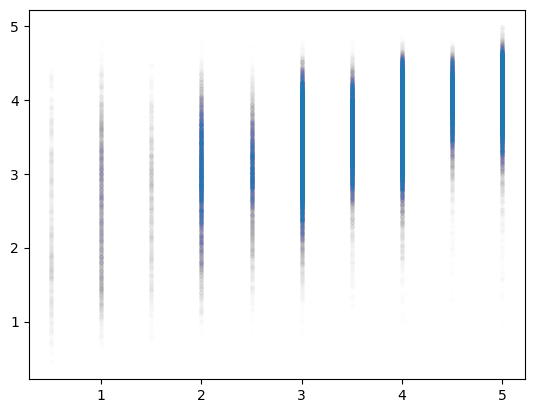
- 전체적으로 우상향 \(\to\) 그럭저럭 잘맞춤
(2) 아래는 유저 2303번에 대한 정보이다.
df_train.query("userId == 2303")| userId | movieId | rating | timestamp | title | genres | |
|---|---|---|---|---|---|---|
| 6142 | 2303 | 111 | 4.0 | 868103611 | Rumble in the Bronx (Hont faan kui) (1995) | Action|Adventure|Comedy|Crime |
| 12399 | 2303 | 295 | 5.0 | 868103784 | Pulp Fiction (1994) | Comedy|Crime|Drama|Thriller |
| 121626 | 2303 | 854 | 5.0 | 868103861 | Godfather, The (1972) | Crime|Drama |
| 166612 | 2303 | 5 | 5.0 | 868103615 | Heat (1995) | Action|Crime|Thriller |
| 177956 | 2303 | 430 | 5.0 | 868103965 | Carlito's Way (1993) | Crime|Drama |
| 182689 | 2303 | 730 | 3.0 | 868103615 | Rock, The (1996) | Action|Adventure|Thriller |
| 200985 | 2303 | 607 | 4.0 | 868103615 | Fargo (1996) | Comedy|Crime|Drama|Thriller |
| 229027 | 2303 | 1383 | 4.0 | 868104228 | Mars Attacks! (1996) | Action|Comedy|Sci-Fi |
| 230673 | 2303 | 1458 | 5.0 | 868103861 | Donnie Brasco (1997) | Crime|Drama |
| 232189 | 2303 | 1561 | 4.0 | 868103699 | Face/Off (1997) | Action|Crime|Drama|Thriller |
| 298169 | 2303 | 1266 | 5.0 | 868103818 | Akira (1988) | Action|Adventure|Animation|Sci-Fi |
| 351345 | 2303 | 94 | 3.0 | 868103425 | Broken Arrow (1996) | Action|Adventure|Thriller |
| 406288 | 2303 | 774 | 5.0 | 868103861 | Trainspotting (1996) | Comedy|Crime|Drama |
| 420897 | 2303 | 1540 | 4.0 | 868104432 | Con Air (1997) | Action|Adventure|Thriller |
| 430816 | 2303 | 1055 | 5.0 | 868103985 | William Shakespeare's Romeo + Juliet (1996) | Drama|Romance |
| 435186 | 2303 | 17 | 4.0 | 868104228 | Four Rooms (1995) | Comedy |
| 439509 | 2303 | 1057 | 4.0 | 868104200 | Sleepers (1996) | Thriller |
| 441292 | 2303 | 1399 | 4.0 | 868103699 | Scream (1996) | Comedy|Horror|Mystery|Thriller |
| 539383 | 2303 | 795 | 4.0 | 868103888 | Frighteners, The (1996) | Comedy|Horror|Thriller |
| 576643 | 2303 | 1421 | 4.0 | 868103699 | First Strike (Police Story 4: First Strike) (G... | Action|Adventure|Comedy|Thriller |
유저 2303는 스릴러를 좋아하는 것 같다. 영화 {49: Usual Suspects, The (1995)} 는 스리럴중에서도 인기가 있는 영화인데, 유저 2303는 아직 이 영화를 시청하지 않은듯 보인다.
df_train.query("'Usual Suspects, The (1995)' in title")| userId | movieId | rating | timestamp | title | genres | |
|---|---|---|---|---|---|---|
| 4281 | 2 | 49 | 3.0 | 840207617 | Usual Suspects, The (1995) | Crime|Mystery|Thriller |
| 4282 | 5 | 49 | 5.0 | 994071051 | Usual Suspects, The (1995) | Crime|Mystery|Thriller |
| 4283 | 7 | 49 | 5.0 | 938947646 | Usual Suspects, The (1995) | Crime|Mystery|Thriller |
| 4284 | 20 | 49 | 5.0 | 1101142801 | Usual Suspects, The (1995) | Crime|Mystery|Thriller |
| 4285 | 32 | 49 | 5.0 | 1162149613 | Usual Suspects, The (1995) | Crime|Mystery|Thriller |
| ... | ... | ... | ... | ... | ... | ... |
| 6007 | 1306 | 49 | 5.0 | 835963893 | Usual Suspects, The (1995) | Crime|Mystery|Thriller |
| 6008 | 1318 | 49 | 5.0 | 840631188 | Usual Suspects, The (1995) | Crime|Mystery|Thriller |
| 6009 | 1320 | 49 | 3.5 | 1352723562 | Usual Suspects, The (1995) | Crime|Mystery|Thriller |
| 6010 | 1321 | 49 | 5.0 | 839429098 | Usual Suspects, The (1995) | Crime|Mystery|Thriller |
| 6011 | 1330 | 49 | 5.0 | 834683823 | Usual Suspects, The (1995) | Crime|Mystery|Thriller |
1731 rows × 6 columns
유저 2303에게 이 영화를 추천하면 어떠한 평점을 줄까? (1)에서 학습한 네트워크로 예측하여 보라.
2. hello – 30점
아래와 같이 hello가 반복되는 자료가 있다고 하자.
txt = list('hello')*100
txt[:10]
['h', 'e', 'l', 'l', 'o', 'h', 'e', 'l', 'l', 'o'](1) torch.nn.RNN()을 이용하여 다음문자를 예측하는 신경망을 설계하고 학습하라. – 12wk-2, 3-C 참고
(2) torch.nn.RNNCell()을 이용하여 다음문자를 예측하는 신경망을 설계하고 학습하라. – 12wk-1, hw 참고
(3) (2)의 결과와 동일한 적합값을 출력하는 신경망을 직접설계한뒤 학습시켜라. (초기값을 적절하게 설정할 것)
class rNNCell(torch.nn.Module):
    def __init__(self):
        super().__init__()
        self.i2h = ????
        self.h2h = ????
        self.tanh = ????
    def forward(self,??,??):
        ht = ????
        return ht
위의 클래스의 ????를 체워 (2)의 결과와 동일한 적합값이 나오도록 하라. – 12wk-1, hw 참고
- class를 이용하지 않으면 점수없음.
torch.nn.RNN(),torch.nn.RNNCell()을 이용한 네트워크를 학습시킬시 점수 없음. (초기값을 셋팅하는 용도로는 torch.nn.RNN(), torch.nn.RNNCell()을 코드에 포함시키는 것이 가능)
(4) torch.nn.LSTM()을 이용하여 다음문자를 예측하는 신경망을 설계하고 학습하라. – 13wk-1, 4-C 참고
(5) torch.nn.LSTMCell()을 이용하여 다음문자를 예측하는 신경망을 설계하고 학습하라. – 13wk-1, 4-A 참고
(6) (5)’의 결과와 동일한 적합값을 출력하는 신경망을 직접설계한 뒤 학습시켜라. (초기값을 적절하게 설정할 것) – 13wk-1, 4-B 참고
- class를 이용하지 않아도 무방함.
- torch.nn.LSTM(), torch.nn.LSTMCell() 을 이용한 네트워크를 학습시킬시 점수 없음. (초기값을 셋팅하는 용도로는 torch.nn.LSTM(), torch.nn.LSTMCell()을 코드에 포함시키는 것은 가능)
이 문제는 전체적으로 https://guebin.github.io/DL2022/posts/2022-11-29-13wk-2-final.html 의 1번과 비슷하니 해당문제 정답을 참고하셔도 됩니다. (근데 제가 다시보니까 데이터정리하는 방식등이 미묘하게 좀 바껴있어서요, 올해 강의노트에서 보고 베끼는게 좋을것 같습니다. 이건 뭐 알아서하세요)
3. FrozenLake – 30점
ref: https://www.gymlibrary.dev/environments/toy_text/frozen_lake/
아래는 OpenAI Gym 라이브러리에서 제공하는 환경 Frozen Lake를 구체화하여 변수 env에 저장하는 코드이다.
env = gym.make('FrozenLake-v1', desc=None, map_name="4x4", is_slippery=False, render_mode='rgb_array')Frozen Lake 환경은 강화학습(RL) 실험을 위한 간단한 시뮬레이션 환경으로 에이전트가 얼어붙은 호수 위를 안전하게 건너 목표 지점에 도달하는 것이 목표이다. 주요 특징은 다음과 같다.
1. 환경 구성:
- 격자형(grid) 환경으로 이루어져 있으며, 각 격자는 4x4 또는 8x8의 형태를 가질 수 있다. (문제에서는 4x4)
- 격자는 시작 지점(Start), 목표 지점(Goal), 얼음(Ice), 그리고 구멍(Hole)으로 구성된다.
- 에이전트는 시작 지점에서 목표 지점까지 이동해야 한다.
2. 에이전트의 동작:
- 에이전트는 상, 하, 좌, 우로 이동할 수 있다.
- 얼음 위에서는 자유롭게 이동할 수 있지만, 구멍에 빠지면 에피소드가 종료된다.
3. 보상 체계:
- 에이전트가 목표 지점에 도달하면 +1의 보상을 받는다.
- 그 외에는 보상이 없다(0 보상).
- 구멍에 빠지거나 목표 지점에 도달하지 못하면 보상은 없다.
4. 목표:
- 에이전트는 강화학습 알고리즘을 사용하여 최적의 경로를 학습하고, 가능한 한 구멍에 빠지지 않고 목표 지점에 도달하는 것이다.
아래는 show 함수이며, 이는 env의 현재상태를 렌더링해주는 역할을 한다.
def show(ims):
    fig = plt.Figure()
    ax = fig.subplots()
    def update(i):
        ax.imshow(ims[i])
    ani = FuncAnimation(fig,update,frames=len(ims))
    display(IPython.display.HTML(ani.to_jshtml()))
show() 함수의 사용방법은 아래와 같다.
env.reset()
plt.imshow(env.render())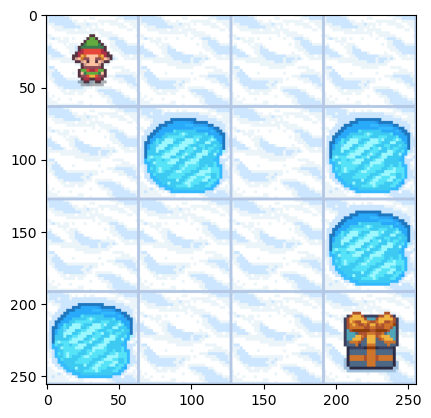
적당한 위의 환경에 대응하는 Agent를 설계하고 q_net를 이용하여 올바른 행동을 학습하라. 아래는 학습된 결과의 예시이다.
# 학습과정 -- 제가 설정한 게임 클리어 판단 조건은 최근 100번의 score가 0.9 이상일경우입니다. 에피소드:500 경험(t):3048 점수(에피소드):0.08 게임시간(에피소드):6.10 돌발행동(에피소드):0.61
에피소드:1000 경험(t):5824 점수(에피소드):0.29 게임시간(에피소드):5.55 돌발행동(에피소드):0.37
에피소드:1500 경험(t):8768 점수(에피소드):0.54 게임시간(에피소드):5.89 돌발행동(에피소드):0.22
에피소드:2000 경험(t):11134 점수(에피소드):0.41 게임시간(에피소드):4.73 돌발행동(에피소드):0.14
에피소드:2500 경험(t):14067 점수(에피소드):0.78 게임시간(에피소드):5.87 돌발행동(에피소드):0.08
---game cleared in 2832 episodes! ---show(imgs)힌트1: 14wk-1,2 의 코드가 아닌 15wk-1 의 코드를 참고하세요
힌트2: 아래의 에이전트를 설계에 이용하세요
class AgentRandom:
    def __init__(self,env):
        #--# define spaces
        self.action_space = env.action_space
        self.state_space = env.observation_space
        #--# replay buffer
        self.current_state =  None
        self.action = None
        self.reward = None
        self.next_state =  None
        self.terminated = None
        #-#
        self.buffer_size = 50000
        self.current_states = collections.deque(maxlen=self.buffer_size)
        self.actions = collections.deque(maxlen=self.buffer_size)
        self.rewards = collections.deque(maxlen=self.buffer_size)
        self.next_states = collections.deque(maxlen=self.buffer_size)
        self.terminations = collections.deque(maxlen=self.buffer_size)
        #--# other information
        self.n_episodes = 0
        self.n_experiences = 0
        self.playtimes = []
        self.score = 0
        self.scores = []
    def act(self):
        self.action = self.action_space.sample()
    def learn(self):
        pass
    def save_experience(self):
        self.current_states.append(torch.tensor(self.current_state))
        self.actions.append(torch.tensor(self.action))
        self.rewards.append(torch.tensor(self.reward).float())
        self.next_states.append(torch.tensor(self.next_state))
        self.terminations.append(torch.tensor(self.terminated))
        #--#
        self.n_experiences = self.n_experiences + 1
self.score = self.score + self.reward힌트3: q_net의 첫 레이어는 torch.nn.Embedding()을 이용하세요
- 상태공간(state space)이 0~15일텐데,
상태1 x 2 = 상태2,상태3 + 상태2 = 상태5와 같은 관계가 성립한다고 보기 어려우므로 상태공간은 범주형변수로 봐야겠죠?
4. O/X – 10점
다음을 읽고 참 거짓을 판단하라.
(1) Dropout Layer를 추가하면 layer의 추가로 인해 모형이 더 복잡해지며 그 결과 모형이 과적합될 수 있다.
(2) CNN에서 torch.nn.Conv2d() 로 만들어지는 레이어는 입력이미지의 특징을 추출하는 역할을 하며, 훈련과정에서 학습되지 않는다.
(3) MF-based 추천 시스템에서는 사용자의 성향과 항목의 성향을 내적하여 궁합을 계산한다.
(4) LSTM은 RNN과 비교할때 장기기억에 강점을 보인다.
(5) 강화 학습에서 에이전트가 현재 상태에서 취하는 행동은 ’리워드(Reward)’라고 한다.